
Dade Sheriff Release Paths
The Dade County Sheriff's Office is the originating law-enforcement and records agency for many local arrests. Its role may include arrest, booking identifiers, transport, warrant returns, and delivery under a Dade court order. That role does not prove that the person stayed in a Dade-owned jail bed until release. Dade detainees can be housed at the Cedar County Detention Center in Stockton. A person committed on a Missouri prison sentence can instead be delivered to the Missouri Department of Corrections.
A true community release may follow bond, dismissal, time served, a court order, or another lawful end to confinement. A transport to Cedar, MODOC, another county, the U.S. Marshals Service, or ICE ends one agency's custody event but does not mean the person is free. The Dade entry should identify the authority and destination if those fields are maintained. Cedar or the receiving agency may own the next event. This difference is the key to reading Dade County Sheriff's Office release records accurately.
Confirm a Dade Sheriff Release
No verified official Dade roster, release archive, 24-hour list, 72-hour list, or sheriff inmate app is available in the research. A missing roster entry therefore cannot answer when or why someone left. The reliable route begins with the official Dade County directory, followed by the actual detention custodian and the public Dade court case. The full named-person search and records route also appears on the Dade County released inmates home page.
Use a narrow sequence so each source answers the question it controls:
- Call the Dade County Sheriff with the full legal name, Dade case number, and approximate custody dates. Ask where the person was physically held.
- Request Dade's arrest or booking identifier, transport log, release or transfer entry, legal authority, and receiving agency or destination, if maintained.
- If Dade identifies Cedar as the housing jail, request Cedar's admission, movement, and release transaction. Ask whether the code means community release or pickup by another custodian.
- Search Missouri Case.net and select the 28th Judicial Circuit. Compare the bond, warrant, judgment, and disposition entries with the custody record.
- Check MOVANS for a timely status lead, then verify the event with the agency record. Notification status is not a certified release record.
Identity must be checked beyond a name. A booking number, case number, date of birth when appropriate, and the detention dates reduce the risk of joining two people's records. A court entry can explain why release was authorized, but it may not show the minute the person left after hold checks and transport processing.
Dade Sheriff Release Records
A focused Missouri Sunshine request should seek an existing “release-event or custody-movement record.” That phrase is more precise than asking for every file about a person. Ask for the arrest or booking identifier, location of detention, admission and release times if Dade keeps them, release type, legal authority, and receiving agency. Add the booking photograph only if Dade took or maintains it. Request the open part if another part is closed.
| Requested field | What it can establish |
|---|---|
| Booking or arrest identifier | Connects the Dade event to the right person and case. |
| Holding location | Identifies whether Cedar or another custodian owns the jail record. |
| Release or transfer time | Shows when Dade responsibility changed, if maintained. |
| Release authority | Links the movement to bond, a court order, sentence, or agency action. |
| Destination | Distinguishes community release from successor custody. |
| Transport log | Documents movement to Cedar, MODOC, court, or another agency. |
The official directory does not publish a dedicated Sheriff Sunshine form, records email, or fee schedule. Call first and ask for the current records custodian, submission address, accepted delivery method, and estimate. Under RSMo 610.023, the custodian must act on a request as soon as possible and no later than the end of the third business day by providing access or a detailed explanation of delay. That is a response deadline, not a promise of full production in three days.
Note: Ask for electronic delivery and an itemized estimate, but do not apply the Circuit Clerk's separate court-copy prices to Sheriff records.
Dade Sheriff Records Contact
The Sheriff is the first contact when the physical holding site is unknown. The office can identify whether Dade kept the person locally, sent the person to Cedar, returned the person for court, or transported the person onward. It should not be asked to create a Cedar database report that it does not possess.
Dade County Sheriff's Office
Sheriff: Ryan Robison
County address: 300 W. Water Street, Greenfield, MO 65661
County telephone: 417-238-2400
Records method: Call for the current custodian, address or email, hours, and fee schedule
The courthouse address comes from the official county directory. It is a contact point, not a verified public release lobby. No official source states a regular release hour, waiting place, weekend process, property window, or ride service. Families should identify the actual releasing jail before traveling or waiting at a building.
The Dade County Circuit Clerk controls the court file, not the Sheriff's jail movement record. The clerk's page supports a 28th Circuit Case.net search and provides a copy form when the judgment or docket document is not remotely available. Those court records can confirm bond, dismissal, sentence, probation, or commitment, while the Sheriff or jail record supplies physical movement.
Dade Sheriff Directory Record
The county directory is the verified public source for the Sheriff and county contact details.
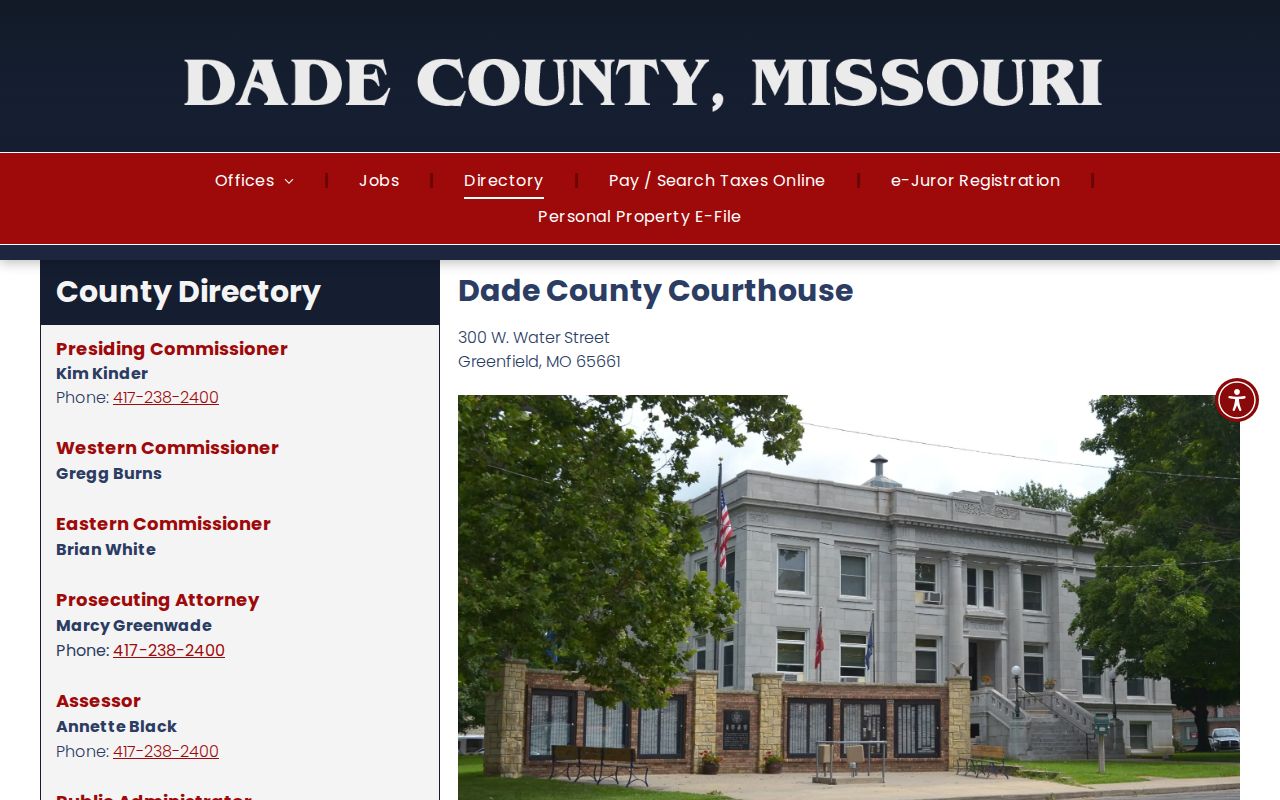
The directory image supports the local identity and contact route. It does not show a live jail roster, release time, or a released-person archive.
Dade and Cedar Release Records
Intercounty housing is the distinctive Dade County facility issue. The official Cedar facility page says its detention center holds people from several counties, and a published Cedar County Commission account separately counted Dade prisoners there. The count is only a past operational snapshot. It still confirms why a “Dade County” custody event can produce a release transaction in Stockton.
The record chain usually divides by action. Dade may own the arrest report, probable-cause papers, warrant return, local booking identifier, court transport, and the order to move the person. Cedar may own detention admission, cell or housing movement, property entries, bond receipt, release timestamp, release code, destination, and a booking image created there. The court owns the judgment, bond order, and public docket. Each custodian should be asked only for the existing fields it keeps.
Errors follow the same ownership rule. A wrong arresting agency or transport entry should go to Dade. A wrong Cedar release time or destination should go to Cedar. A judgment error belongs with the court record process. If the person later entered MODOC, state sentence and discharge fields belong to the department. Sending a precise correction to the field owner is more effective than sending the same broad complaint to every office.
The same split affects a request for proof. A Dade response may correctly state that no local jail release record exists because Cedar performed the jail transaction. That response is not proof that the person stayed in custody or that no Dade case existed. It is a direction to the next custodian. Likewise, Cedar may have no Dade arrest narrative because Cedar admitted the person under another county's authority. Keeping both identifiers in each request lets the two event records be matched without asking either county to recreate the other's work or guess at missing release details.
Dade Release Terms Explained
Release language often describes only one step. Reading the terms in context prevents a Dade-to-Cedar move or Dade-to-MODOC commitment from being reported as freedom.
- Bond release
- Physical custody ends under bond terms while the criminal case may remain pending.
- Time served
- The credited custody period reaches the endpoint set by the court and jail calculation.
- Transfer
- One custodian ends control because another county, MODOC, USMS, or ICE receives the person.
- Parole
- Prison confinement ends while the state sentence and community supervision remain active.
- Discharge
- The correctional or supervision relationship ends, not merely the stay in one jail.
Dade release proof is strongest when the movement timestamp, release type, destination, and court authority agree. A roster disappearance proves none of those points by itself. MOVANS can flag a change quickly, and Case.net can supply legal context, but the originating and holding custodians remain the primary record sources.